
Court costs
Court costs correspond to the procedural costs.
There are two types of court costs: (art. 95 al. 1 let. a et al. 2 CPC (Civil Procedure Code)):
- Fees (fixed conciliation fee and fixed decision fee)
- Costs (of evidence taking, translation and child representation)
Fees
The Fees (art. 95 al. 2 let. a et b CPC)
are a contribution to the overall operating costs of the justice system (conciliation and decision-making). They therefore do not cover the full costs of the justice system.
They are calculated by the court on the basis of the value in dispute and are estimated at the time the petition or application is filed with the competent court. These fees are therefore, in principle, subject to
an advance payment on costs, which is required at the start of the procedures. In its judgment, the court sets the costs and divides them between the parties. The amount not covered by the advance payment of costs must be paid by the parties, depending on the outcome of the procedures.
The competent court may request additional advance payments on costs if the initial amount advanced is no longer sufficient.
To calculate the advance on costs, the Tribunal civil relies on:
- The civil procedure code (CPC)
- The loi d'application du code civil suisse (LaCC) and other federal laws relating to civil matters
- The règlement fixant le tarif des frais en matière civile (RTFMC)
- The tarif interne des demandes d'avances de frais pour le Tribunal de première instance
The courts may require the claimant to pay an advance on costs (art. 98 CPC) of up to half of the estimated legal costs. In certain areas, the advance on costs may be paid in full. With some exceptions, this applies to the following cases:
- Conciliation
- Summary procedures
- Second instance procedures
Costs of taking evidence, translation and child representation
The costs of taking evidence, translation and child representation (art. 95 al. 2 let. c à e CPC) are related to the evidence presented during the procedure. These may include witness hearings, expert fees, requests for assistance from foreign courts, translation or interpreting costs, etc.
Party costs
The party costs (art. 95 al. 1 let. b et al. 3 CPC) are procedural indemnities charged to one party in favour of the other to compensate that party for the expenses or loss of earnings incurred as a result of the trial.
The party costs include, on the one hand, indemnities relating to lawyers' or agents' fees and, on the other hand, disbursements (ancillary costs such as the preparation of certificates, certified copies, attestations, photocopies, publication in the Feuille d'avis officiel [FAO] or the Feuille officielle suisse du commerce [FOSC], etc.).
Allocation of costs
When rendering its decision, the court determines the share of costs to be borne by each party. In general, the unsuccessful party bears the costs of the procedure, including the costs owed to the opposing party (art. 106, al. 1 CPC). Where the proceedings result in only partial success, the court shall apportion the costs in proportion to the result obtained by each party or, where appropriate, compensate them (art. 106, al. 2 CPC).
The allocation of costs is thus directly determined by the outcome of the dispute, according to criteria set out in the Civil Procedure Code.
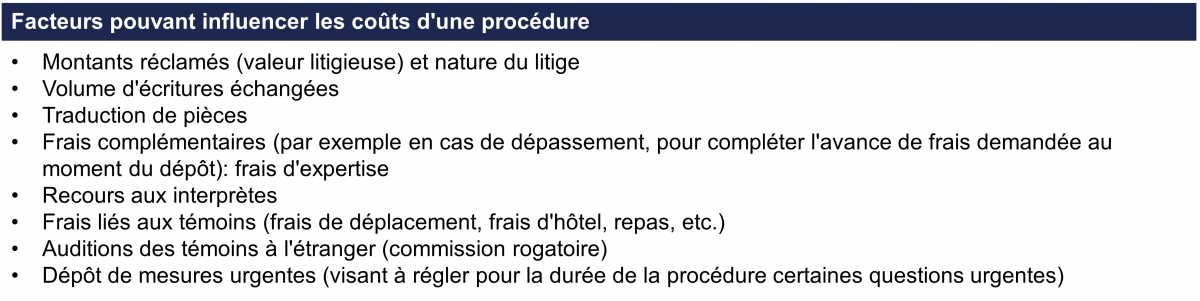
Factors that may influence the procedural costs
The litigant must pay the procedural costs on the one hand and his/her solicitor's fees on the other.
Legal aid – financial assistance
When a party is unable to pay court fees and solicitor's or representative's fees, he /she may apply for legal aid.
This service covers all or part of the costs, provided that the conditions for eligibility are met.
It should be noted that legal aid does not cover the other party's costs (party costs). These are to be paid by the losing party, as determined in the judgment.
Mediation – an alternative to legal procedures
The mediation (art. 213ss CPC) is a conflict resolution process whereby a mediator, who is a neutral, impartial and independent third party, facilitates communication between the parties involved and helps them to find a fair and lasting solution to their conflicts themselves.
A mediation office attached to the Judiciary power was established on January 1, 2024. It grants financial assistance, in particular covering the cost of mediation sessions (7.5 hours of mediation, renewable up to three times), under the following conditions:
- The mutual and concordant willingness of the persons concerned
- The use of a sworn mediator registered with the tableau genevois
- Sufficient connection between the dispute and the canton of Geneva.