Civil law covers a wide range of topics, such as divorce, inheritance, disputes relating to leases and rents, and labour law disputes.

Civil procedure – overview
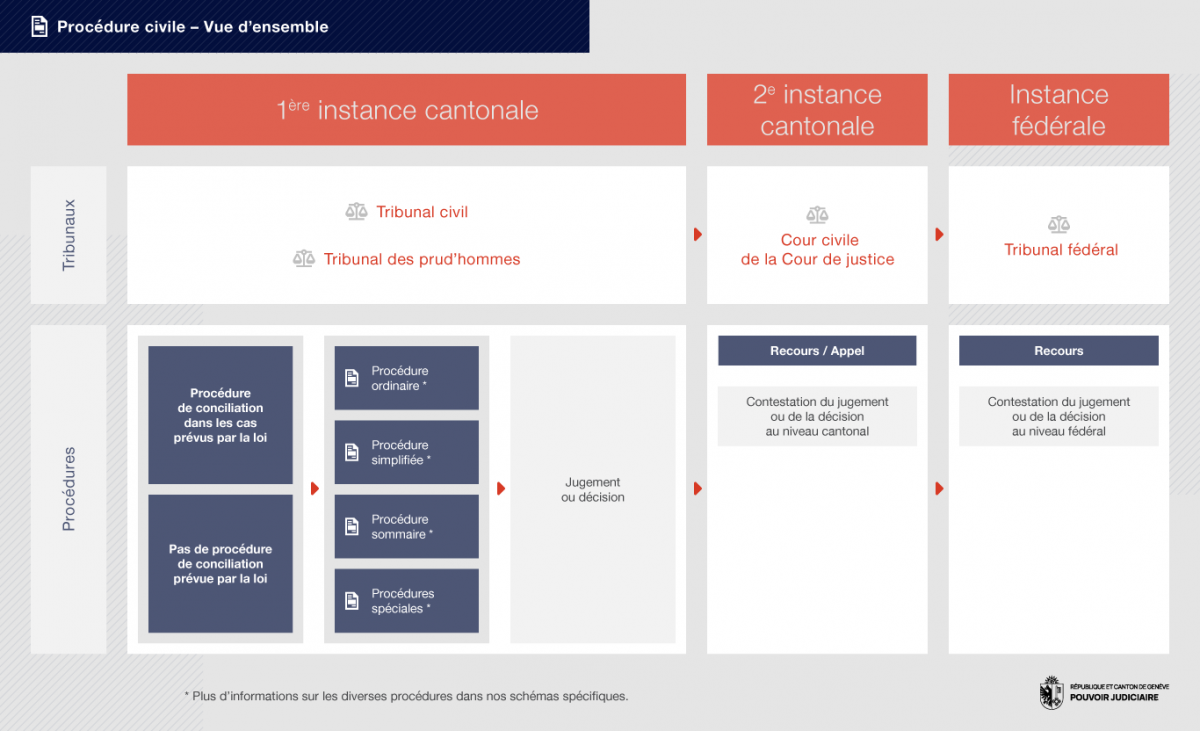
Distinction between the cantonal first instance and the second instance
Procedures generally start in first instance. In specific cases provided for by law, the Cour civile of the Cour de justice has competence to hear certain disputes as the sole cantonal court, known as the single instance (e.g. in the areas of unfair competition, intellectual property, etc.).
When the decision of the first instance is contested (appeal or objection), the dispute is decided in a second instance.
The decision of the second instance may be contested before the Federal Court.
In Geneva, the courts of first instance in civil matters are:
- The Tribunal civil (which includes the Tribunal de première instance, the Commission de conciliation en matière de baux et loyers, as well as the Tribunal des baux et loyers)
- The Tribunal des prud'hommes
The court of second instance in civil matters is:
- The Cour de justice (a Civil court, which includes the chambre civile, the chambre des baux et loyers, the chambre des prud'hommes and the chambre de surveillance)
At federal leval:
- The Tribunal fédéral
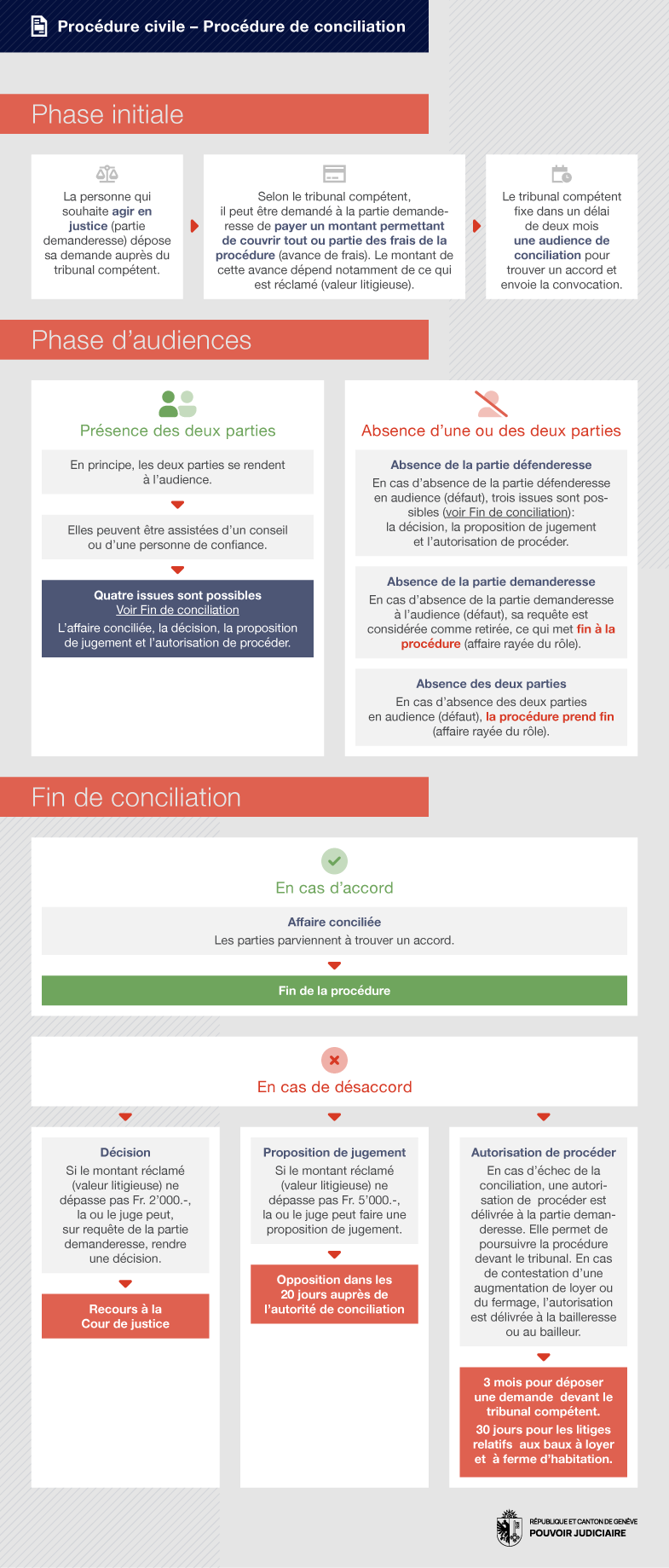
Conciliation
The parties (known as the ‘claimants’ and ‘defendants’) are summoned to one or more hearings. The conciliation procedure may result in an agreement between the parties. This agreement then has the force of a judgment, in which case the procedure is terminated.
The parties are summoned to one or more hearings. The conciliation procedure may result in a full or partial agreement between the parties. This agreement then has the force of a judgment.
- In the event of a full agreement, the procedure is terminated.
- Otherwise, authorisation to proceed is granted and the procedure continues.
Conciliation is free of charge in disputes concerning contracts concluded with consumers (Art. 32 of the Civil Procedure Code), in disputes concerning rental leases before the Labour Court and in other cases provided for in Article 113 para 2 CPC (e.g. disputes under the Gender Equality Act).
Otherwise, court fees are charged for the conciliation procedure.<
Once authorisation to proceed (continuation of procedure before the court) has been granted, the applicant has three months (30 days for disputes relating to rental leases) to bring the case before the court (Art. 209 CPC).
In disputes concerning challenges to rent or usufructuary lease increases, authorisation to proceed is granted to the lessor, who has 30 days to pursue the procedure before the court (Art. 209 para. 4 CPC).

The ordinary procedure
The ordinary procedure begins, in principle, with an attempt at conciliation, even if a conciliation procedure, which was unsuccessful, has already taken place.
An ordinary procedure can be divided into 3 stages:
- Initial phase
- Hearing phase
- Decision-making phase
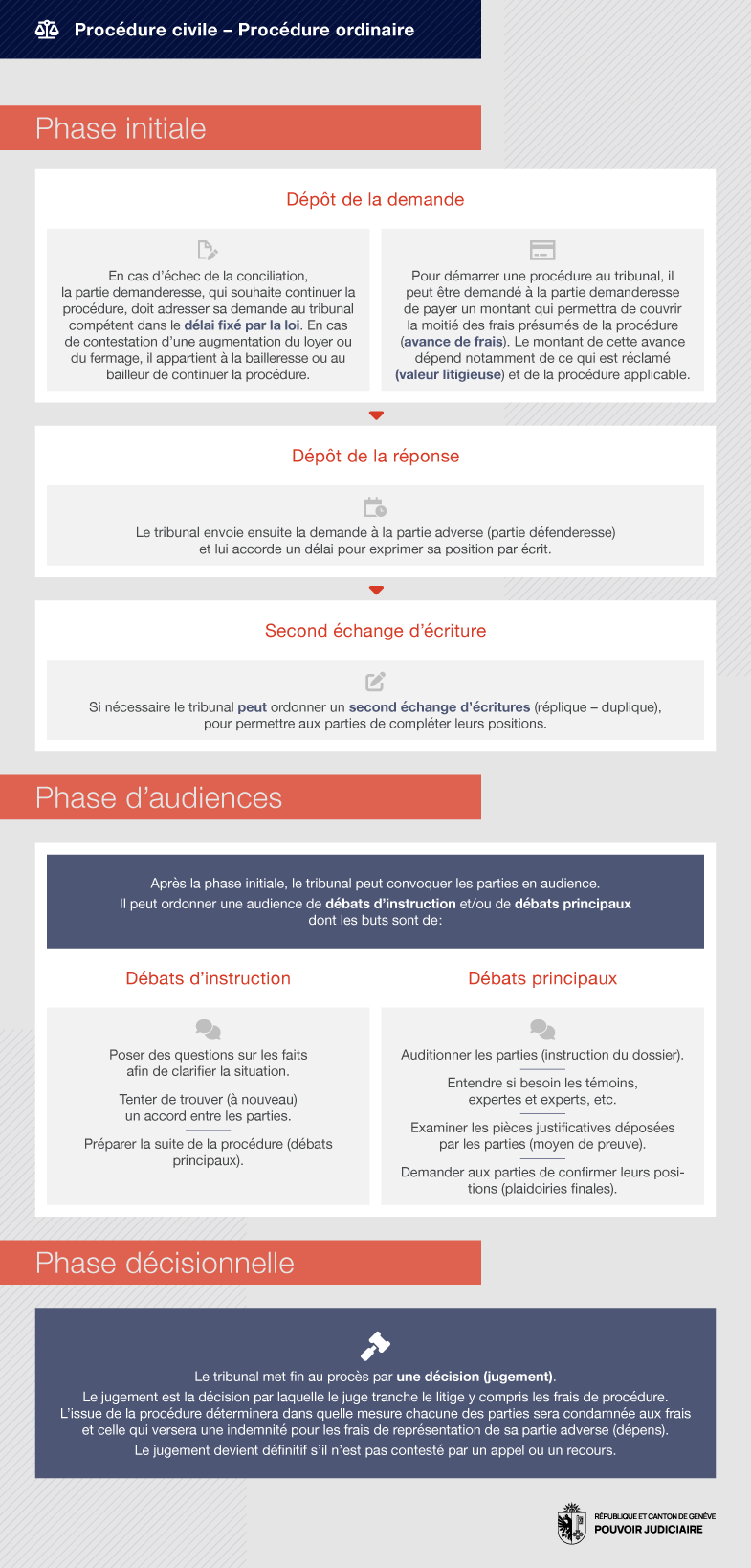
The court or conciliation authority may require the claimant to pay an advance of up to half of the estimated legal costs (Art. 98 para. 1 CPC).
A full advance payment is required in the following cases (Art. 98 para. 2 CPC):
- Conciliation
- Summary procedures
- Second instance procedures
The court fees that are charged represent only a contribution to the overall operating costs of the justice system; they do not pass on the full cost to litigants.
There are also other types of procedures besides ordinary procedures, namely simplified procedures and summary procedures.
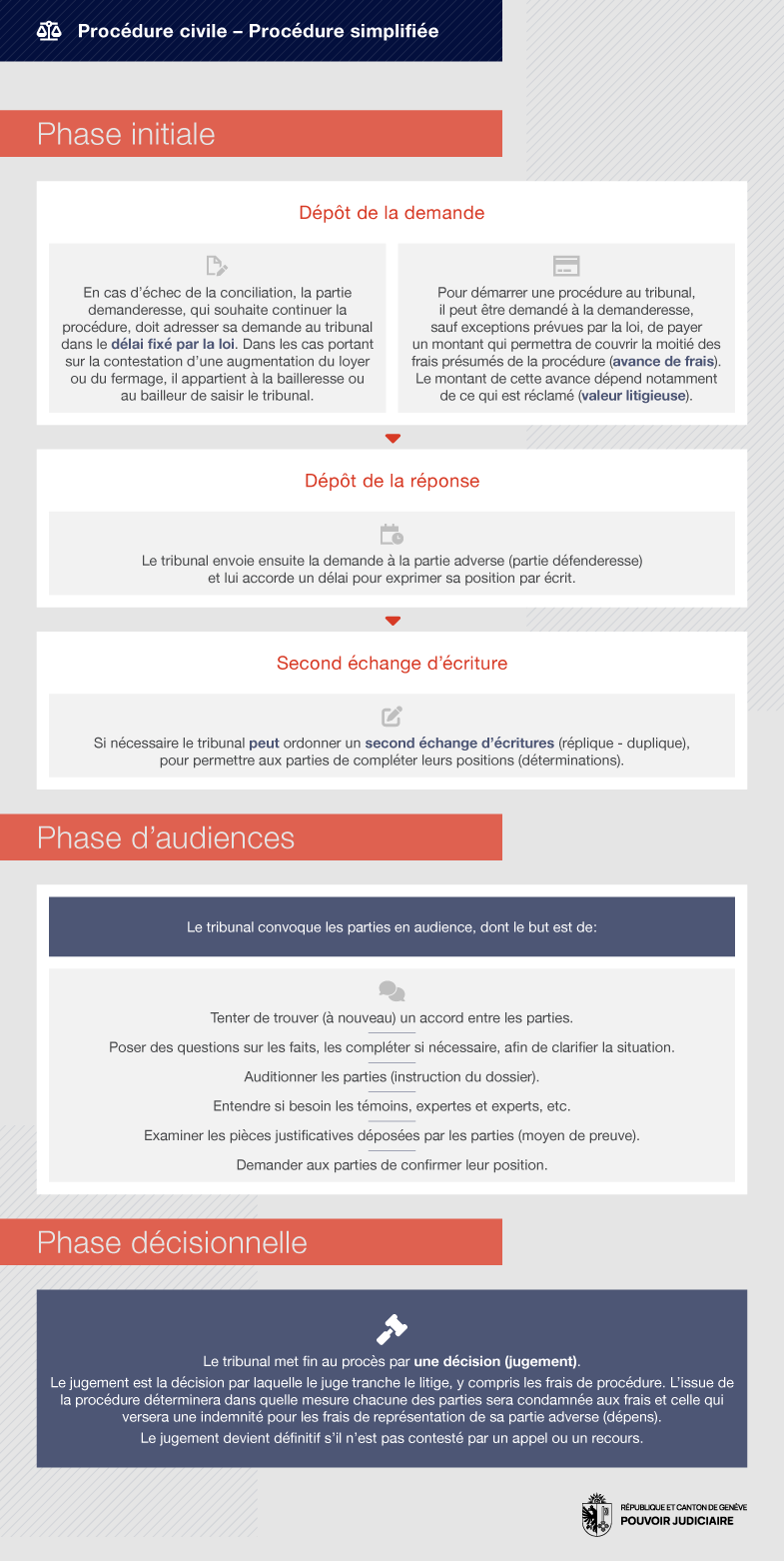
The simplified procedure
The simplified procedure is initiated after the failure of a conciliation procedure by filing an application with the competent court.
- It applies to property matters where the value in dispute does not exceed Fr. 30,000.- (Art. 243 et seq CPC).
- It also applies in the specific cases listed in article 243 para. 2 of CPC regardless of the amount in dispute. These include disputes under the Gender Equality Act, disputes involving violence, threats or harassment (protection of personality rights), and disputes concerning rental agreements or usufructuary leases relating to termination, deposit or calculation of rent for residential or commercial premises.
This type of procedure is distinguished by the fact that it is faster and less demanding for the parties than ordinary procedures.
- The application does not need to be substantiated, but must contain what the applicant wishes to obtain (conclusions).
- The judge may ask the parties to supplement their allegations and/or evidence.
The aim is to settle the dispute at the first hearing, but an exchange of written submissions and additional hearings may be ordered if circumstances so require.
Detailed guide to the simplified procedure
Summary procedure
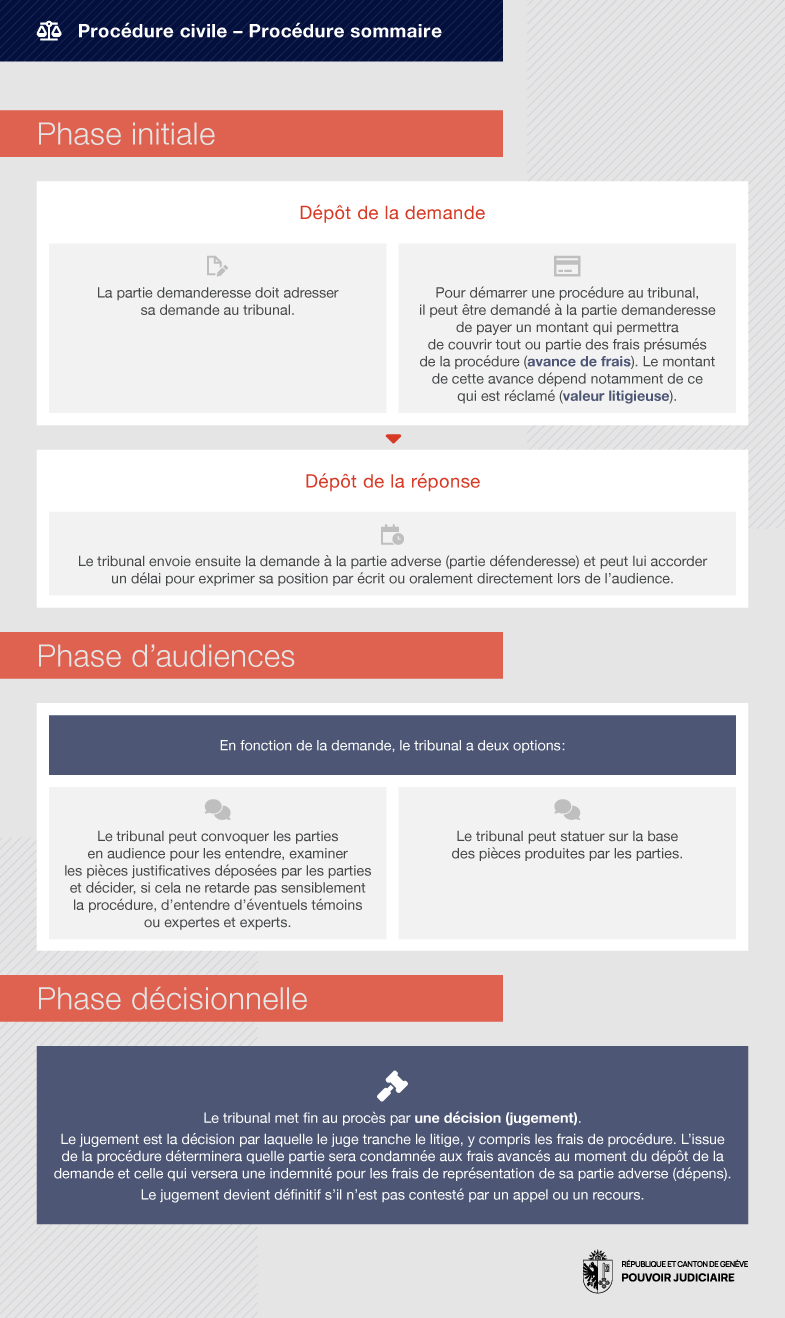
The Summary procedures are characterised by the fact that they are not subject to prior conciliation and are generally intended to be swift. There are numerous cases in which this type of procedure applies, and these are listed in article 248 et seq of CPC. For example, the declaration of bankruptcy at the request of a creditor is decided in summary procedures, without a prior conciliation hearing.
Detailed guide to a summary procedure
Family law procedures
Family law procedures cover, in particular:
- Marital law (art. 271 et seq CPC)
- Matters related to children (art. 295 et seq CPC)
- Matters related to a registered partnership (art. 305 et seq CPC).
Although the procedures in this area have a few specific features, they are essentially similar to other types of procedures (initial phase, hearings and then decision-making).
Objection/appeal
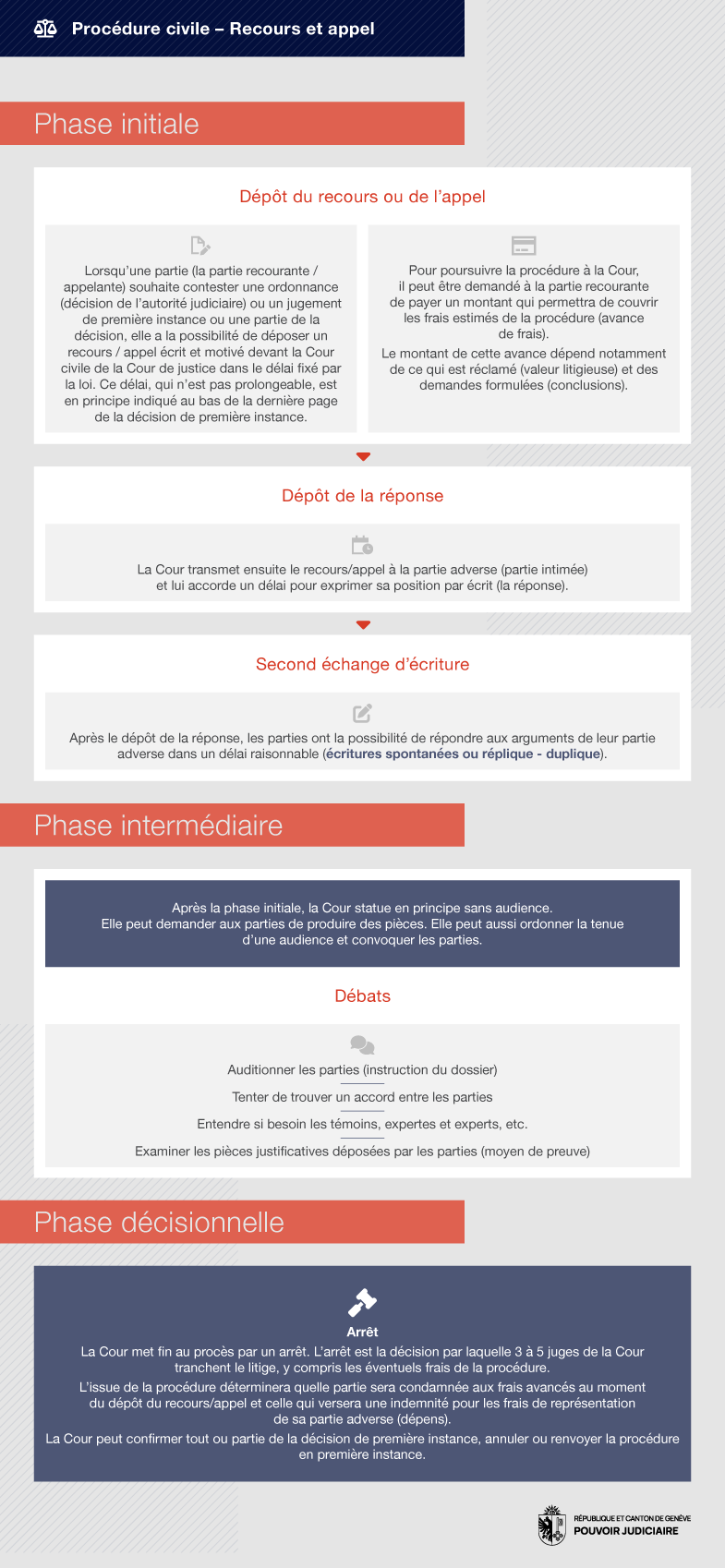
When a party wishes to challenge the first instance decision or part thereof, it lodges an objection/appeal with the Cour civile of the Cour de Justice, within the legal time limit, which is normally indicated on the last page of the first instance decision.
Detailed explanation of the objection/appeal procedure
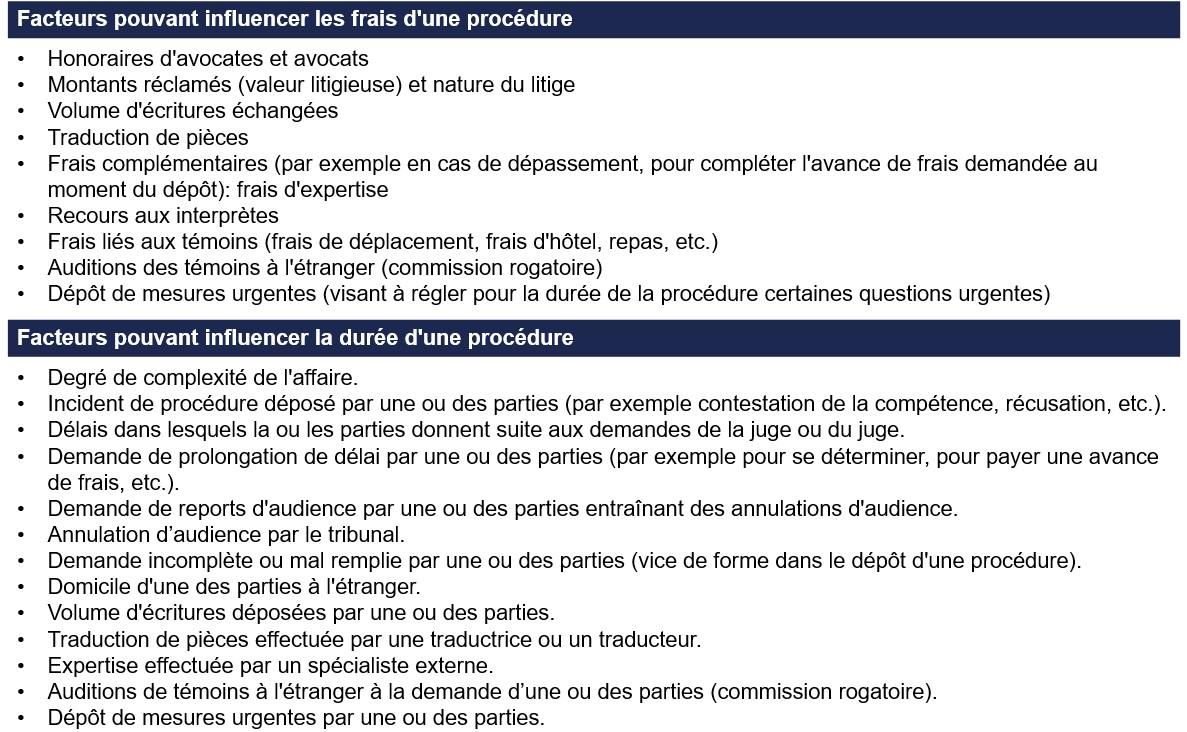
The duration and costs of a procedure
The duration and costs of a procedure may vary depending on the circumstances. The table below shows the main factors that may influence the course of a procedure, both in terms of duration and costs.