A legal framework for the digital justice in Switzerland
Adopted on 20 December 2024, the Federal Act on Electronic Communication Platforms in the Judicial Field (ACPJ) amends the federal procedural law to require the transition to electronic judicial files. It establishes the framework applicable to electronic communication and consultation between judicial authorities, lawyers, administrative authorities and parties acting without legal representation.
The law provides for the creation of a public corporation bringing together the cantons and the Confederation, named justitia.swiss, which will be responsible for operating and developing an electronic communication and consultation platform in the judicial field.
From a procedural point of view, the ACPJ provides in particular for:
- The obligation for judicial and criminal authorities (courts, public prosecutors, police) to maintain and manage court records in electronic form;
- The obligation for these same authorities to communicate electronically with lawyers, other professionally qualified representatives and administrative services or offices;
- The obligation for lawyers, other professionally qualified representatives and administrative services and offices to communicate electronically with judicial and criminal authorities or to consult court files online;
- The possibility for natural or legal persons acting in court without a representative to do the same.
The implementing regulations for the law are currently being drafted and are expected to be subject to national consultation in early 2026.
Possible Schedule for the digital transition in Geneva
The ACPJ became partially effective on 1 October 2025, to enable the establishment of the public corporation justitia.swiss and to confer supervisory powers on the Federal Data Protection and Transparency Commissioner.
The Federal Council will determine when the other provisions of the law will come into force. This is expected to be in January 2027. The cantons and the Confederation will then be able to decide whether to switch to mandatory digital judicial files, at the earliest one year and at the latest five years after the ACPJ comes into force. Within this timeframe, the cantons may set a different date for proceedings governed by the Code of Civil Procedure (including proceedings before adult and child protection authorities) and for proceedings governed by the Code of Criminal Procedure. The cantons will also be free to adapt their administrative procedural law to provide for the transition to electronic judicial files in this area, which falls within their jurisdiction.
In Geneva, the Judicial Power is considering a digital transition in three distinct stages, by branch (civil, criminal and administrative). Each stage will be planned by the cantonal authorities. For example, the main stages of the digital transition of the justice system in Geneva could be as follows:
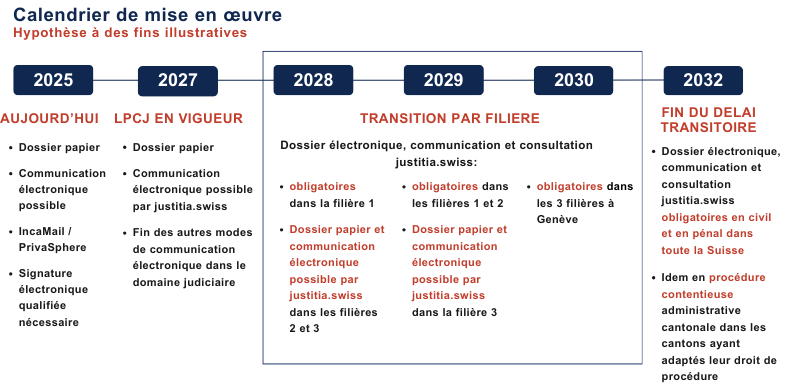
- 2025: Paper files, electronic communication possible, IncaMail/PrivaSphere, qualified electronic signature required
- 2027 (ACPJ in force): Paper files, electronic communication possible via justitia.swiss, end of other electronic communication models in the judicial field
- 2028: Electronic files, communication and consultation via justitia.swiss mandatory in branch 1. Paper files and electronic communication possible via justitia.swiss in branches 2 and 3
- 2029: Electronic files, communication and consultation via justitia.swiss mandatory in branches 1 and 2. Paper files and electronic communication possible via justitia.swiss in branch 3
- 2030: Electronic files, communication and consultation via justitia.swiss mandatory in all three branches in Geneva
- 2032: End of transition period: Electronic files, communication and consultation via justitia.swiss mandatory in civil and criminal cases throughout Switzerland. The same applies to cantonal administrative litigation proceedings in cantons that have adapted their procedural law.
Justitia 0.4 : the national project

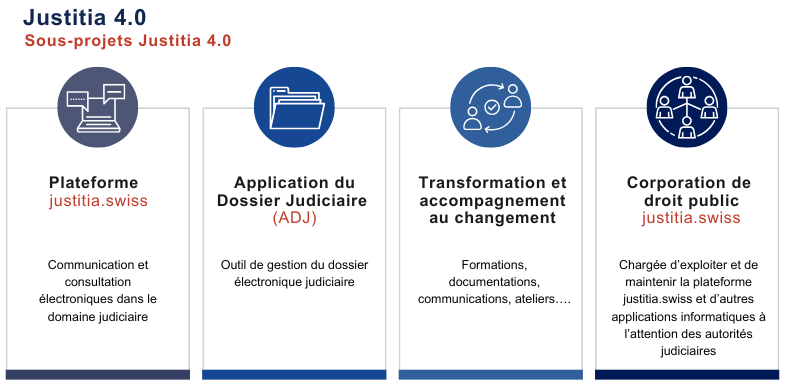
The national project Justitia 4.0 comprises four sub-projects.
- It has developed the central platform justitia.swiss for electronic communication and consultation in the judicial field.
- It is currently developing the judicial file application (JFA), which should enable judicial authorities to work efficiently with an electronic file.
- It designs and implements change management support measures (sub-project known as Transformation,) to support judicial authorities and lawyers.
- It is also preparing the creation of the public law corporation justitia.swiss.
The digital transition of the justice system affects nearly 300 cantonal and federal courts, cantonal and federal public prosecutors' offices, as well as professional associations such as the Swiss Bar Association and cantonal bar associations. All areas of the justice system are involved: civil, criminal and administrative.
The platform justitia.swiss
In future, electronic communication with and by judicial authorities, as well as consultation of files, will be carried out online via the secure central platform justitia.swiss.

Approximately 30,000 justice system employees, as well as lawyers and cantonal and federal government departments and offices, will be required to use it. Natural persons and legal entities may also use it, but are not obliged to do so.
The judicial file Application (JFA)
Today, judicial files are in paper format, divided into various sections (folders or files), mainly consisting of ring binders. They are accompanied by working notes intended for the judicial authorities. The judicial file Application (JFA) transposes these familiar practices into a fully digital environment. It allows users to create, manage and consult electronic judicial files, and to take advantage of the many opportunities offered by the change in format:
- Simultaneous consultation and access to case documents, enabling greater efficiency in collaboration on the one hand and promoting remote working on the other;
- Annotation and highlighting of documents, with the option to share these enhanced documents with others working on the case;
- Search function to facilitate case review, hearing preparation, or decision drafting;
- Task creation and planning to organise the work of all individuals involved in the case and ensure deadlines are met.
In 2023, the governing bodies of Justitia 4.0 approved the decision to helvetize the digital workstation used by the Austrian judiciary. This solution was chosen because it meets the functional needs of the judicial authorities, offers interoperability with existing professional applications and allows the judicial authorities to have access to the computer code and, therefore, not be dependent on a private supplier.
eJudicial file : the Geneva program
The ejudicial file program is a program launched by the judiciary power to carry out the digital transition of the Geneva justice system. It complements the national project, which is not intended to support the cantonal judicial authorities in the practical implementation of this reform.

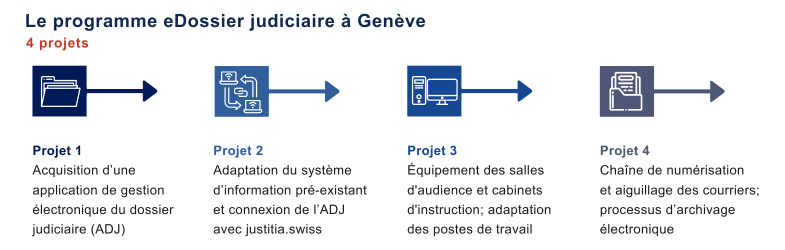
The eJudicial file program in Geneva : 4 projects
- Project 1 : Acquisition of an electronic management application of the judicial file (JFA)
- Project 2 : Adaptation of the pre-existing information system and connection of the JFA with justitia.swiss
- Project 3 : Equipment of courtrooms and investigation chambers; adaptation of workstations
- Project 4 : Mail scanning and routing chain; electronic archiving process
The programme aims to prepare the judiciary power for electronic case management:
- To adapt the information system (application development, integration of JFA and interaction with the justitia.swiss platform, etc.)
- To strengthen the IT infrastructure, particularly storage capacity, computing power and cybersecurity.
- Equip workstations and courtrooms to enable work with electronic judicial files.
- Adapt work processes to electronic judicial files.
- Design spaces and acquire digitisation software and equipment.
- Define and implement change management support measures.
Pilot phase in Geneva
Testing the platform justitia.swiss
The Tribunal civil was chosen to test the justicia.swiss plateform as part of a pilot phase. Since September 2024, three chambers have been using the platform in real conditions to test its main features:
- Communication of letters, pleadings and documents by lawyers;
- Service and notification of documents and decisions by the court;
- Partial availability of files for online consultation.

This phase proved successful, enabling a very positive initial assessment to be made. It confirmed that the platform was functioning properly and that users were satisfied.
The Bar Association supported the judiciary power in this pilot phase.
Test of the judicial file Application (JFA)
On October 17, 2025, The Geneva judiciary has taken a new step forward with the use of the Judicial File Application (JFA) in real conditions at the Tribunal Civil.

Three chambers have participated to this pilot projet working on a limited number of procedures, to compile and manage files in electronic form, while testing the many features available to judges and scientific and administrative staff. The number of chambers involved will increase over the coming months.
At the same time, a similar pilot project has been run by the Tribunal administrative Fédéral (TAF) since 20 October 2025. Both pilot projects aim to gather concrete feedback on the use of JFA. The lessons learned will be used to guide the functional development of the solution with a view to its gradual roll-out nationwide, scheduled for 2027.