Addressing real needs
Increase in the number of cases and measures
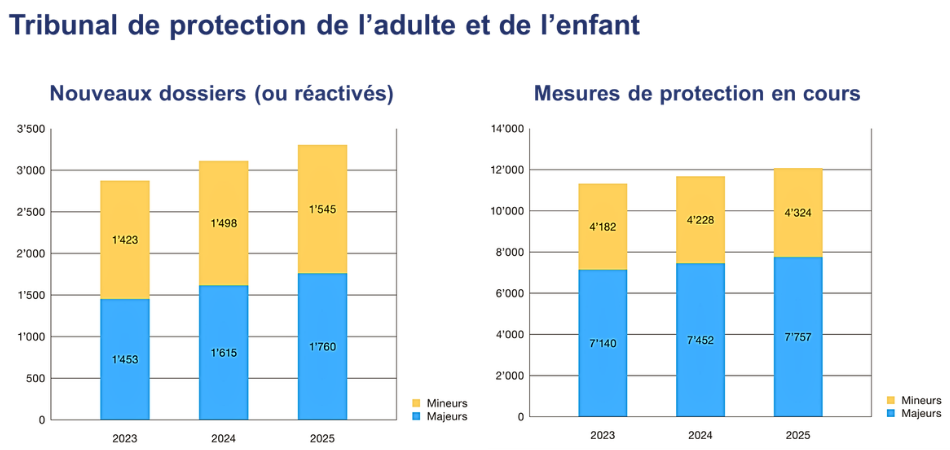
Since 2019, the number of cases handled by The Tribunal de protection de l'adulte et de l’enfant (TPAE) has risen by 21.5 per cent, from 11,734 to 14,256 cases.
This significant increase in cases is accompanied by increasingly complex situations, particularly as a result of the ageing population. Whilst the new legislation introduced in 2013 was intended to reduce the number and scope of protective measures, the needs of the population have continued to grow.
This reform aims to better align the resources deployed by the canton with these actual needs.
Report on the Activities of the Judiciary power in 2025
Management of agents
Launched in February 2021, this program aims to improve the selection, monitoring and supervision of agents appointed by the TPAE — deputies and estate administrators, whether they are private individuals, professionals or institutions (Office de protection de l'adulte — OPAd, Office cantonal de l’enfance et de la jeunesse — OEJ) to ensure better protection for vulnerable people.
Main objectives:
- To define the rules governing the administration of mandates (recruitment, appointment, duties, continuity) and to develop tools to optimise their implementation (key principles).
- To create a centralised register of professional private agents to identify those best suited to the needs of litigants (Agents’ register).
- Review the supervisory rules and introduce a new model for monitoring agents in Geneva (steering and monitoring).
- Automate communications with the OPAd and the OEJ to improve their efficiency.
Key achievements to date:
- Establishment of the bureau de soutien aux mandataires (BSM) (Agent Support Office) at the TPAE.
- Launch of the Agents’ Register (RegMan): a web-based application enabling magistrates to quickly identify the most suitable professional private agent for each situation and to gain a consolidated overview of current mandates through a single repository and a tool to assist with the appointment process.
- The guide des mandataires has been made avaible online on the Judiciary power’s website. Organised according to the TPAE’s three areas of activity (minors, adults and successions), this resource is aimed at both new agents and experienced professionals. Its purpose is to clarify the mandate entrusted to them, to set out the Court’s expectations regarding the tasks to be carried out, and to promote practices that comply with the required standards.
- Clearing the backlog of deputyship reports, as part of a project.
Rethinking adult protection for the future: the RePAir program
Launched in January 2023 jointly by the Department for Social Cohesion (DCS) and the Judiciary power, the RePAir program aims to provide better support and assistance to the most vulnerable people in dealing with the administrative, legal, social, medical and/or financial difficulties they face, until they regain their independence where possible, whilst respecting their right to self-determination.
It operates on three levels:
- Prior to an adult protection measure
- Whilst providing care for a person subject to an adult protection measure
- Following an adult protection measure
Main objectives:
- To strengthen the implementation of the principles of subsidiarity and proportionality in adult protection measures.
- To improve the quality of support provided to people subject to an adult protection measure.
- To reduce the risk of a person being placed under an adult protection measure again after a measure has been lifted.
Key achievements to date:
- Assessment of the current situation and panel of deputies: an assessment has helped to better identify the need to diversify the panel in line with the needs of those under deputyship and to analyse the current system through inter-cantonal comparisons covering the legal framework, management, training and support for deputies, as well as the support provided to those concerned. This work serves as the basis for revising the criteria for allocating mandates according to profiles, adapting the remuneration system and strengthening the training framework.
- Pro Senectute pilot project: this two-year pilot project has a twofold objective: to handle deputyship cases involving people aged 65 and over, and to carry out social enquiries following reports concerning people aged 55 and over. This social investigation scheme aims to support the decision-making of TPAE judges in their assessments, with a view to identifying, where the situation permits, alternatives to deputyship.
- The Allocation and Remuneration project: drafting a preliminary bill aimed at improving the quality of support provided to those affected, whilst strengthening their ability to assert their choices and preferences.
- Proposal to designate an Authority to which applications for mandates for incapacity are submitted (MCI): the Tribunal de la protection de l’adulte et de l’enfant (TPAE) has been proposed as the body responsible for the filing of mandats pour cause d’inaptitude. A preliminary draft bill has been drawn up to this end. Phase 2 will involve organisational, logistical and IT system changes to implement this legislation.
- Draft communication on cantonal adult protection measures: to better inform the public about adult protection measures in the canton, with a view to strengthening the implementation of the principles of subsidiarity and proportionality in relation to such measures.
Questions/answers
The programme RePAir (Rethinking Adult Protection for the Future) was launched in January 2023 by the Judicial power and the Département de la cohésion sociale et de la solidarité.
It pursues three main objectives:
- Reinforcing the application of the principles of proportionality and subsidiarity* of the measure
- Improving the quality of support for people subject to adult protection measures
- Reducing the risk of people being placed under adult protection once a measure has been lifted
* Principle according to which the protection authority may only take protective measures if the assistance required by the person concerned cannot be provided by his or her family, close relatives or the competent public or private services.
To better protect the most vulnerable people: the ever-increasing needs of a part of the population, namely the elderly and young adults, have led to an increase in the number of reports to the Tribunal de protection de l’adulte et de l’enfant, particularly since the pandemic of COVID-19.
Two effects have been observed. Firstly, there has been an increase in the number of people concerned, but above all an increase in the needs of each of them. And secondly, the observation that the situations have become increasingly complex.
This has led to an increase in the number of measures ordered by the TPAE and entrusted to the OPAd or to private deputies, which are ordered only after the situation has been investigated and if they are necessary.
By taking action on three levels,
- Before a measure is ordered by the protection authority (the TPAE)
- During provision of care to a person subject to a protective measure
- Subsequently to the measure
The current reform will help to improve support for vulnerable people throughout their lives by:
- improving the information available on the accessible resources in the field of social action and on adult protection measures
- deploying an innovative support system for people concerned by a report before any adult protection measures are taken:
- reviewing the criteria for awarding and remunerating mandates, as well as the training, guidance and support provided to deputies
Ultimately, the aim is to provide better protection for the most vulnerable.
* Principle according to which the protection authority may only take protective measures if the assistance required by the person concerned cannot be provided by his or her family, close relatives or the competent public or private services.
The Agent Management program will ultimately benefit three main groups:
- The people concerned: to better meet the needs of people placed under protective measures, the aim of the Agent Management program is to improve the match between the designated agent and the needs and situation of the person concerned.
- Agents: clear information available on the Internet, simplified contacts with the court.
- The court: clarification and optimization of internal processes for the benefit of those concerned, agents and TPAE staff.
Around one in four deputies is a relative. The Agent Management program RePAir (GMR) aims to take a heterogeneous look at the allocation of curatorship mandates.
To better take into account the needs of all parties and ensure the relevance of the program's results, the Judicial power has involved a panel of representatives.